
macOS Fake Update Screen
Create a high-fidelity fictional Mac update scene with live progress, pause, restart, loop, and natural fullscreen exit.
Related tools

Practical uses for macOS Fake Update Screen
- Stage a fictional update scene for a video or presentation.
- Run a harmless, consent-based prank.
- Demonstrate that a browser screen can imitate system UI.
A careful three-step workflow
- 1
Read the independent-simulator disclosure.
- 2
Choose a duration, starting percentage, and whether progress should loop.
- 3
Start the simulation, then enter fullscreen manually; press Escape to return.
Interpret the result in context
- macOS and Mac are trademarks of Apple Inc.; ScreenOrbit is not affiliated with Apple.
- The progress sequence and responsive spacing are generated dynamically.
- State for macOS Fake Update Screen is processed locally and resets from the normal page view.
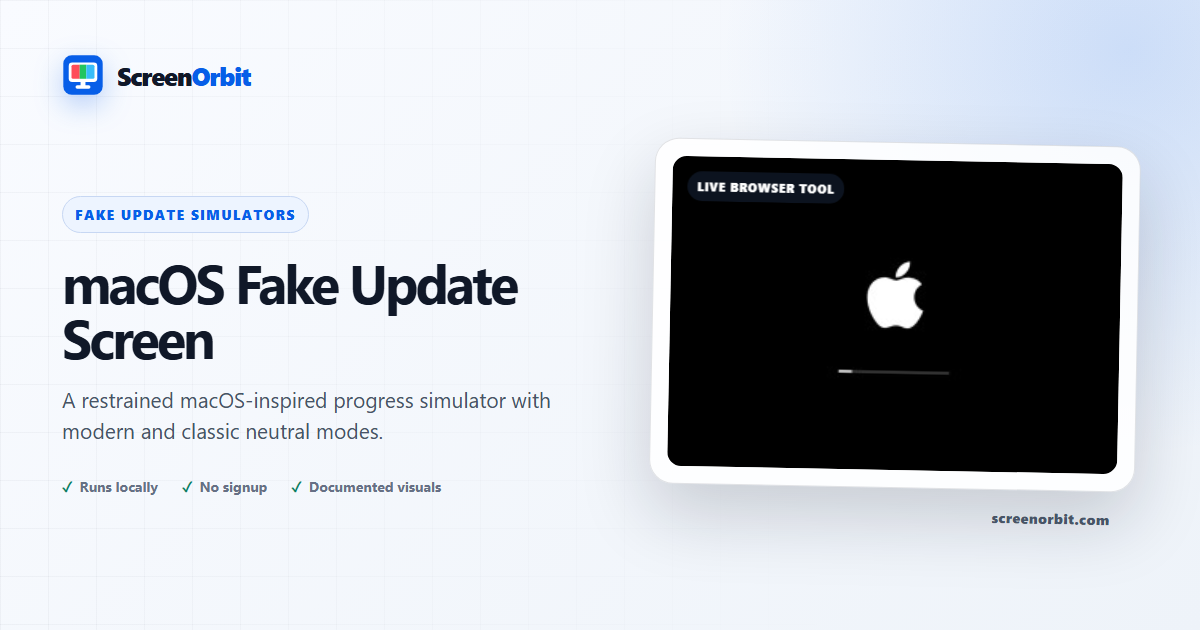
A minimal dark desktop-update simulation
The macOS-style scene uses a black surface and crisp startup artwork. The thin progress indicator is generated live and remains adjustable rather than forming part of a static image. Apple and macOS are named descriptively; ScreenOrbit is not affiliated with or endorsed by Apple.
Harmless browser behavior
Duration and starting progress are user-selected. The loop is optional, progress pauses when the tab is hidden, and Restart returns to the chosen start. Nothing accesses system update services, reads the device, changes software, downloads a package, or requests an administrator password.
Consent and exit
A safety confirmation appears before immersive mode. Fullscreen is never automatic, Escape is not blocked, and the page does not try to restore fullscreen after you leave. Use the page only for a staged recording, design demonstration, or low-stakes prank in which the fictional nature can be disclosed promptly.
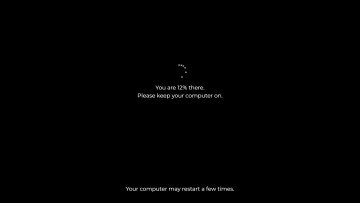
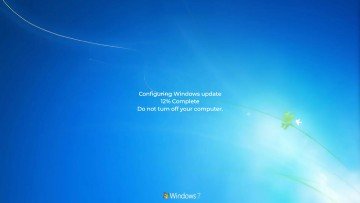
For another dark visual use the Windows 11–style Fake Update; for a period-inspired gradient use the Windows 7–style Fake Update. Learn the warning signs of real social-engineering pages in the recognition guide.
Plan a useful session with macOS Fake Update Screen
macOS Fake Update Screen works best when you start with one question. Decide what you need to view, compare, create, record, or demonstrate. Keep the first run at the default state. Change one control after you understand the starting result. This approach gives you a clear baseline and a useful reason for every adjustment.
Create a high-fidelity fictional Mac update scene with live progress, pause, restart, loop, and natural fullscreen exit. Use the normal page view to prepare the settings. Enter fullscreen only after you review the exit control. Write down the mode and key values when you need to repeat the result on another device.
Plan the macOS Fake Update Screen production frame
The macOS scene favors open spacing, restrained status copy, and a calm desktop composition. Check the center alignment at the final recording size. Keep the browser frame visible during setup. Enter fullscreen only for the planned take. Avoid adding account prompts, repair claims, or unfamiliar support numbers to the scene.
Prepare the scene and run sheet
Match the duration with the length of the shot. A short clip needs steady progress and little text. A classroom exercise needs enough time for viewers to identify browser cues. Save ongoing work before starting. Record the phase order, loop choice, display scaling, and exit step in the shot notes.
Review the recognition cues
Compare the scene with the Software Update panel reached through trusted system settings. The browser address area, fullscreen transition, Escape behavior, and absence of an administrator prompt support recognition. Explain those cues after the exercise. Close the tab and return the Mac to its previous workspace when the session ends.
Choose controls by outcome
The available modes include modern, classic. The control set includes fullscreen, animation, keyboard, safe exit, reset. Start with the option closest to your task. Avoid changing every value at once. A single change gives you a direct before-and-after comparison and makes a saved result easier to explain.
- Stage a fictional update scene for a video or presentation. Set a clear finish point before you begin.
- Run a harmless, consent-based prank. Set a clear finish point before you begin.
- Demonstrate that a browser screen can imitate system UI. Set a clear finish point before you begin.
Run a repeatable workflow
- Stage 1. Read the independent-simulator disclosure. Record the starting environment and state.
- Stage 2. Choose a duration, starting percentage, and whether progress should loop. Keep the first comparison short and controlled.
- Stage 3. Start the simulation, then enter fullscreen manually; press Escape to return. Reset the page when the session ends.
For a device comparison, use the same browser family, viewport, room light, physical brightness, and viewing distance where practical. Run the same order on both devices. Change one environmental factor only after the matched pass is complete. Keep this route focused on this use: Stage a fictional update scene for a video or presentation.
Keep a useful record
A useful record names the page, mode, control values, browser, device, viewport, date, and viewing condition. For a visual observation, describe the location and the fields where the effect appears. For a generated asset, record dimensions, format, color values, and the downloaded file name. For a simulation, record the duration, custom text, disclosure, and exit method. The starting reference for this page is modern.
- macOS and Mac are trademarks of Apple Inc.; ScreenOrbit is not affiliated with Apple.
- The progress sequence and responsive spacing are generated dynamically.
Avoid common setup errors
- For this use, do not treat a browser view as a hardware measurement or system action: Stage a fictional update scene for a video or presentation.
- Do not change several settings before you record the baseline. Begin with modern.
- Do not rely on a phone photograph as the only evidence. Keep this route limit in view: macOS and Mac are trademarks of Apple Inc.; ScreenOrbit is not affiliated with Apple.
- Do not leave route features active after the task ends. The main controls include fullscreen, animation, keyboard, safe exit.
- Do not add private data, credentials, payment details, or confidential text. Keep the second listed use in scope: Run a harmless, consent-based prank.
Continue with the closest comparison
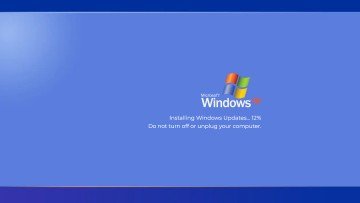
Open a related route when the first page reveals a new question. Keep the same environment and repeat only the part needed for comparison. The closest listed routes are Windows 11 Fake Update, Android Fake Update, Loading Screen Prank. Keep this final use in mind: Demonstrate that a browser screen can imitate system UI.
- Windows 11 Fake Update. A modern update scene with responsive typography, live animation, and fictional status copy.
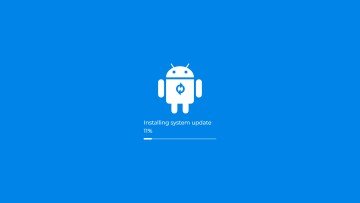
- Android Fake Update. A crisp mobile-update scene with live, responsive Android-style progress behavior.
- Loading Screen Prank. A high-fidelity buffering player with a live title, timeline, duration, loading point, and fullscreen view.
Recommended guides
Questions about macOS Fake Update Screen
What does macOS Fake Update Screen do?
Create a high-fidelity fictional Mac update scene with live progress, pause, restart, loop, and natural fullscreen exit. Stage a fictional update scene for a video or presentation. Run a harmless, consent-based prank.
Who gets the most value from this page?
Use this page when your task matches the listed purpose. Stage a fictional update scene for a video or presentation. Run a harmless, consent-based prank. Start with a clear goal and stop once the page answers that goal.
Which macOS Fake Update Screen setting should you choose first?
Start with modern, classic. Keep the default state for the first pass. Change one control, review the result, then record the setting before another change.
What should you prepare before fullscreen?
Get permission, choose a short duration, rehearse Escape, and make sure no real update or unsaved work is in progress. Read the independent-simulator disclosure. Choose a duration, starting percentage, and whether progress should loop.
Does this page change hardware or system settings?
The timer changes fictional progress inside one tab. The page does not install software, inspect files, restart the device, contact a vendor, or change system settings. The modern mode and Reset affect local page state only.
How should you judge the result?
Use the scene for a planned recording, demonstration, or disclosed joke. Close the tab after the session and verify normal device operation. macOS and Mac are trademarks of Apple Inc.; ScreenOrbit is not affiliated with Apple. The progress sequence and responsive spacing are generated dynamically.
Does the page upload files or settings?
No tool state is uploaded by ScreenOrbit. Supported local files stay in the current browser tab. Generated files are assembled in browser memory and download to your device. The starting mode is modern. The first use is: Stage a fictional update scene for a video or presentation.
Which phones, tablets, and computers support the tool?
Current desktop and mobile browsers support the core page. Fullscreen, Wake Lock, downloads, audio, and local file access depend on browser and operating system support. The visible control set starts with fullscreen. The first use is: Stage a fictional update scene for a video or presentation.
What mistakes reduce the value of the page?
Avoid credentials, support numbers, payment requests, remote access, or claims about real device status. Those elements cross the stated safety boundary. Keep the goal, settings, environment, and exit plan clear. The first listed use is: Stage a fictional update scene for a video or presentation.
Which ScreenOrbit tool should you open after macOS Fake Update Screen?
Continue with Windows 11 Fake Update, Android Fake Update, Loading Screen Prank. The related links preserve the same task area while giving you another field, pattern, or workflow for comparison.