Flip Clock Screensaver
Turn a browser tab into a clean local-time clock without installing an app or using a proprietary clock design.
SCREENUP
Related tools


Practical uses for Flip Clock Screensaver
- Create an easy-to-read desk clock.
- Show a selected timezone during a remote meeting.
- Use a minimal time display in a recording or workspace.
A careful three-step workflow
- 1
Choose 12- or 24-hour format and optional seconds/date.
- 2
Select local time or a supported timezone.
- 3
Start fullscreen and enable display drift if desired.
Interpret the result in context
- The clock uses your browser clock and Intl timezone data.
- Subtle drift only reduces static placement; it cannot prevent OLED wear.
- State for Flip Clock Screensaver is processed locally and resets from the normal page view.
An original browser flip clock for a desk or shared display
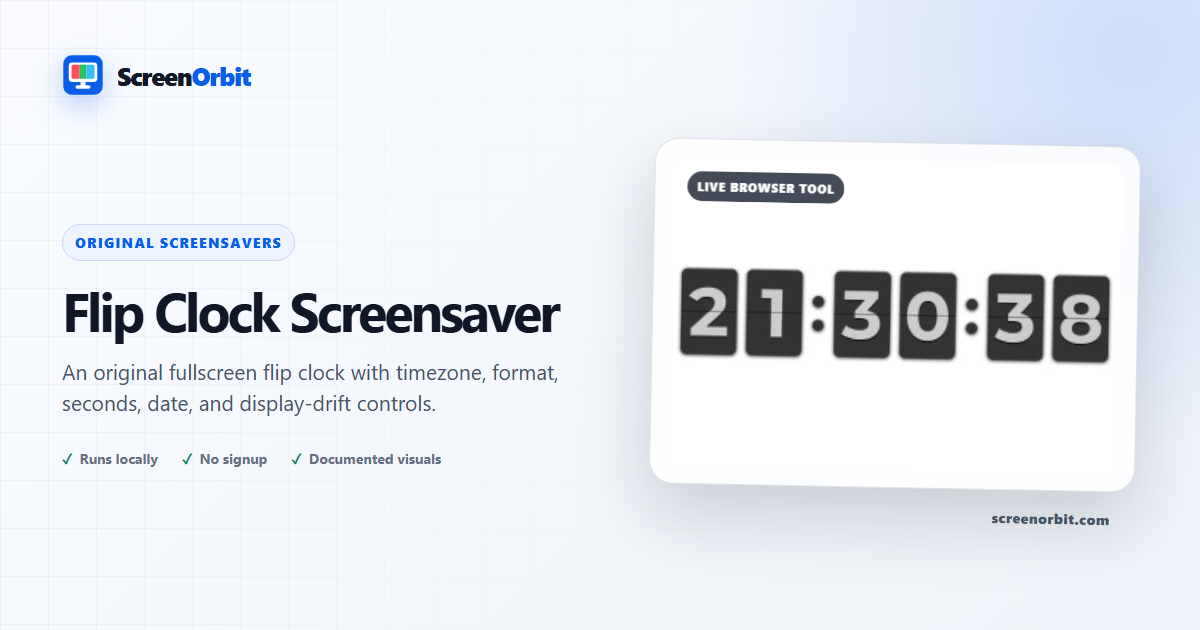
The Flip Clock turns local browser time into a large, legible six-digit display. Its cards, numeral layout, hinge line, and transition are project-authored rather than extracted from a clock application. Choose 12- or 24-hour time, show or hide seconds and the date, select a timezone supported by the browser’s Intl data, and switch between light and dark surfaces.
Time and timezone behavior
Local mode reads the device clock. A selected timezone formats that same instant for another location; ScreenOrbit does not contact a location service and does not infer where you are. Timezone labels come from the browser and availability can differ on older devices. If the computer clock is wrong, the displayed time will also be wrong.
Set up a readable clock
- Select 12- or 24-hour format and decide whether changing seconds are useful or distracting.
- Choose light or dark mode for the room. Adjust physical screen brightness to a comfortable level.
- Enable the date only when the extra line remains readable at the intended distance.
- Use optional position shift for a subtle change in placement over time, then enter fullscreen deliberately.
Display care and browser limits
Position shift can reduce perfectly static placement, but it cannot guarantee protection from image retention or burn-in. Follow the display manufacturer’s guidance, avoid unnecessarily high brightness, and do not leave a static high-contrast image running longer than needed. Wake Lock is optional, browser-dependent, and releases when the page is hidden. The device can still sleep because of operating-system policy, battery state, or unsupported APIs.
The flip motion respects reduced-motion preferences and timers resynchronize from the clock rather than accumulating a frame-by-frame drift. For a quieter text display use the Motivational Quote Screensaver; for moving ambience try the Bouncing Screensaver. No account, location permission, or installed application is required.
Plan a useful session with Flip Clock Screensaver
Flip Clock Screensaver works best when you start with one question. Decide what you need to view, compare, create, record, or demonstrate. Keep the first run at the default state. Change one control after you understand the starting result. This approach gives you a clear baseline and a useful reason for every adjustment.
Turn a browser tab into a clean local-time clock without installing an app or using a proprietary clock design. Use the normal page view to prepare the settings. Enter fullscreen only after you review the exit control. Write down the mode and key values when you need to repeat the result on another device.
Choose controls by outcome
The available modes include light, dark, 12 hour, 24 hour. The control set includes fullscreen, animation, keyboard, wake lock, reset. Start with the option closest to your task. Avoid changing every value at once. A single change gives you a direct before-and-after comparison and makes a saved result easier to explain.
- Create an easy-to-read desk clock. Set a clear finish point before you begin.
- Show a selected timezone during a remote meeting. Set a clear finish point before you begin.
- Use a minimal time display in a recording or workspace. Set a clear finish point before you begin.
Run a repeatable workflow
- Stage 1. Choose 12- or 24-hour format and optional seconds/date. Record the starting environment and state.
- Stage 2. Select local time or a supported timezone. Keep the first comparison short and controlled.
- Stage 3. Start fullscreen and enable display drift if desired. Reset the page when the session ends.
For a device comparison, use the same browser family, viewport, room light, physical brightness, and viewing distance where practical. Run the same order on both devices. Change one environmental factor only after the matched pass is complete. Keep this route focused on this use: Create an easy-to-read desk clock.
Keep a useful record
A useful record names the page, mode, control values, browser, device, viewport, date, and viewing condition. For a visual observation, describe the location and the fields where the effect appears. For a generated asset, record dimensions, format, color values, and the downloaded file name. For a simulation, record the duration, custom text, disclosure, and exit method. The starting reference for this page is light.
- The clock uses your browser clock and Intl timezone data.
- Subtle drift only reduces static placement; it cannot prevent OLED wear.
Avoid common setup errors
- For this use, do not treat a browser view as a hardware measurement or system action: Create an easy-to-read desk clock.
- Do not change several settings before you record the baseline. Begin with light.
- Do not rely on a phone photograph as the only evidence. Keep this route limit in view: The clock uses your browser clock and Intl timezone data.
- Do not leave route features active after the task ends. The main controls include fullscreen, animation, keyboard, wake lock.
- Do not add private data, credentials, payment details, or confidential text. Keep the second listed use in scope: Show a selected timezone during a remote meeting.
Continue with the closest comparison
Open a related route when the first page reveals a new question. Keep the same environment and repeat only the part needed for comparison. The closest listed routes are DVD Screensaver, Motivational Quote Screensaver, Digital Rain Screensaver. Keep this final use in mind: Use a minimal time display in a recording or workspace.
- DVD Screensaver. A precise bouncing badge with classic, custom text, and local-image modes.
- Motivational Quote Screensaver. A calm, typographic quote display using original text and verified public-domain sources.
- Digital Rain Screensaver. Original falling-code ambience with density, speed, color, trail, and glyph controls.
Recommended guides
Questions about Flip Clock Screensaver
What does Flip Clock Screensaver do?
Turn a browser tab into a clean local-time clock without installing an app or using a proprietary clock design. Create an easy-to-read desk clock. Show a selected timezone during a remote meeting.
Who gets the most value from this page?
Use this page when your task matches the listed purpose. Create an easy-to-read desk clock. Show a selected timezone during a remote meeting. Start with a clear goal and stop once the page answers that goal.
Which Flip Clock Screensaver setting should you choose first?
Start with light, dark, 12 hour, 24 hour. Keep the default state for the first pass. Change one control, review the result, then record the setting before another change.
What should you prepare before fullscreen?
Choose a moderate speed, size, and brightness. Review the pause and exit controls before fullscreen. Respect reduced-motion preferences. Choose 12- or 24-hour format and optional seconds/date. Select local time or a supported timezone.
Does this page change hardware or system settings?
The browser experience does not replace a lock screen, sleep timer, security control, calibration process, or manufacturer panel-care feature. The light mode and Reset affect local page state only.
How should you judge the result?
Judge motion by comfort, frame stability, and the intended recording or ambient use. Stop the scene when the display no longer needs to stay active. The clock uses your browser clock and Intl timezone data. Subtle drift only reduces static placement; it cannot prevent OLED wear.
Does the page upload files or settings?
No tool state is uploaded by ScreenOrbit. Supported local files stay in the current browser tab. Generated files are assembled in browser memory and download to your device. The starting mode is light. The first use is: Create an easy-to-read desk clock.
Which phones, tablets, and computers support the tool?
Current desktop and mobile browsers support the core page. Fullscreen, Wake Lock, downloads, audio, and local file access depend on browser and operating system support. The visible control set starts with fullscreen. The first use is: Create an easy-to-read desk clock.
What mistakes reduce the value of the page?
Avoid leaving a bright animated page unattended. Long sessions consume power and do not guarantee protection from image retention. Keep the goal, settings, environment, and exit plan clear. The first listed use is: Create an easy-to-read desk clock.
Which ScreenOrbit tool should you open after Flip Clock Screensaver?
Continue with DVD Screensaver, Motivational Quote Screensaver, Digital Rain Screensaver. The related links preserve the same task area while giving you another field, pattern, or workflow for comparison.